Understanding the design
Review of the drawings, colour palette and relationships between figures and structural elements.


CASE STUDY / 2024
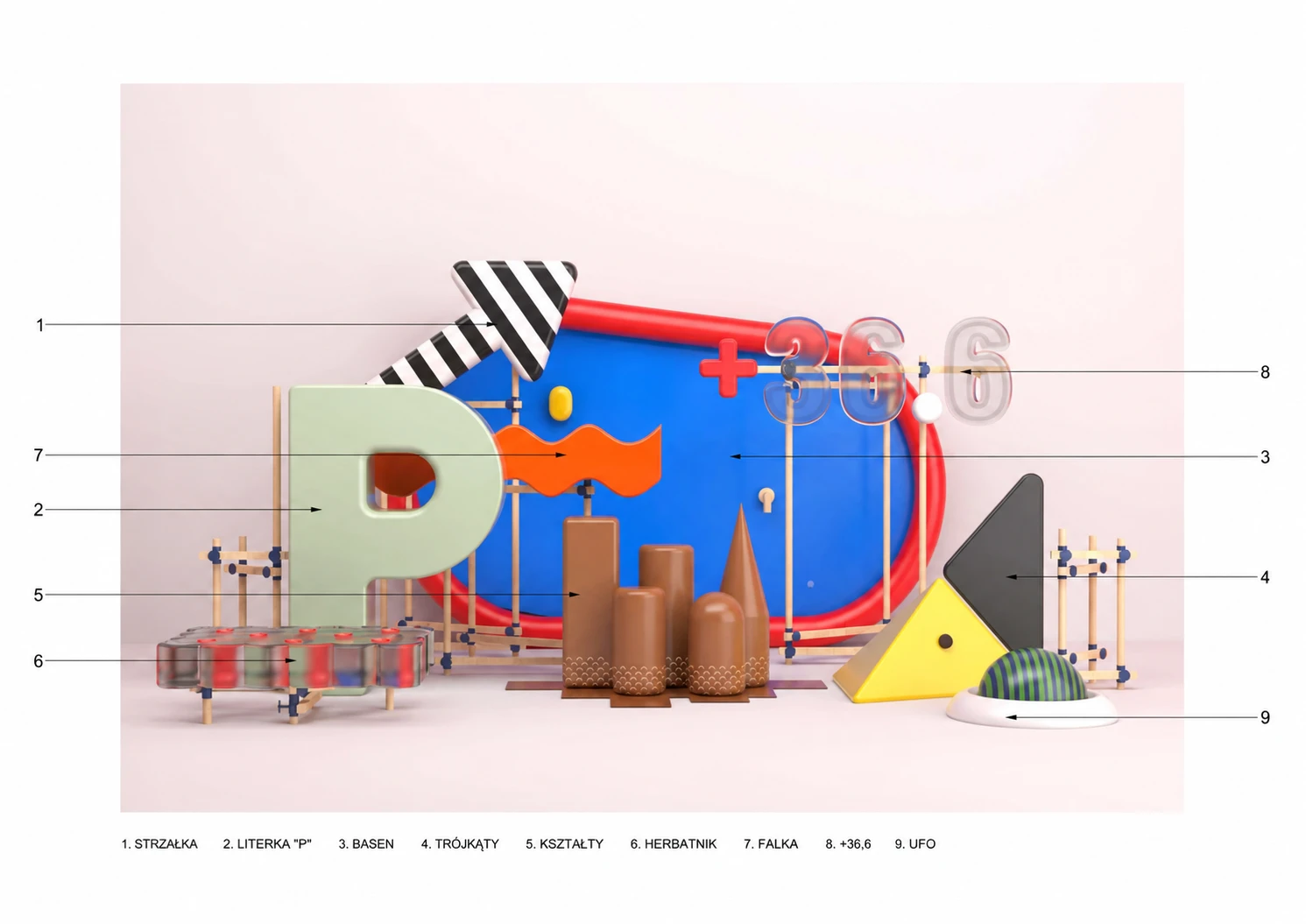
An arrow, a letter, a wave and objects with unexpected shapes. For the “Laboratory of Happiness Research” exhibition, we manufactured a set of nine inflatable figures based on the design by Maciej Siuda’s studio. Each form had its own character; together they formed a coherent, colourful exhibition setting.
01 / Project story
The artistic concept called for drawings to become three-dimensional inflatable forms. The set ranged from a large oval pool to small typographic characters and shapes dressed in printed covers. The challenge was to preserve proportions, colours and recognisable shapes after inflation, while integrating the elements with wooden frames and suspension systems.
02 / Project story
We prepared individual patterns for each figure and selected materials according to the construction documentation. We used PVC, materials identified in the project as POLI, and sewn printed covers. HF and hot-air welding were combined with industrial sewing. Successive inflation trials allowed us to check geometry, airtightness and cover fit, then make adjustments.
03 / Project story
The result was a complete set of nine scenographic figures prepared as a coherent installation. According to the project record, the elements passed airtightness tests and checks against the design documentation. The project shows how WATS’s manufacturing capabilities can support exhibition creators, from developing patterns for an unusual shape to producing a family of objects with a shared visual language.
Step by step
Review of the drawings, colour palette and relationships between figures and structural elements.
Individual patterns for each figure, with selected materials and joining methods.
Cutting, welding the inflatable bodies, and sewing and fitting the printed covers.
Inflation, checks of airtightness and proportions, and adjustments against the design.
Integration with frames and suspension components, followed by a consistency check across the nine figures.
The scenography was an integral part of the exhibition. Colour, scale and geometry shaped the character of the space. Each object required individual attention while maintaining consistency across the set.
| Figure | Distinctive design element |
|---|---|
| Arrow | Black-and-white stripes and a suspension structure |
| Letter P | Pistachio-coloured cover and wooden frame |
| Pool | Large oval shape with a colourful surround |
| Triangles | Contrasting black and yellow |
| Shapes | Cylinders, a cuboid and a cone with a printed cover |
| Biscuit | A distinctive outline with protrusions |
| Wave | An orange undulating profile |
| +36.6° | Small, recognisable typographic characters |
| UFO | A dome and a ring with contrasting stripes |
The drawings established the shapes, while the patterns and joining methods determined their form after inflation. Small characters, curves and printed covers required individual refinement. WATS combined welding and sewing with the installation of valves, frames and suspension components.
Maciej Siuda’s studio prepared the construction design. WATS developed the patterns, selected manufacturing methods and produced the figures. The documentation identifies Bęc Zmiana / Goethe-Institut as the commissioning organisations.
We present an overall visualisation of the scenography by Maciej Siuda’s studio. It shows the concept for the complete set, rather than a photograph of the finished exhibition.
Yes. Construction methods and materials are selected for each project. Explore WATS technologies, event and scenography products and custom projects.
Design materials: Maciej Siuda studio, “Laboratory of Happiness Research”, construction design dated 6 August 2024. The manufacturing account is based on WATS project documentation.
Details and perspectives
Tell us about your project
Meet your WATS team